
Can culture still seek inspiration from the Ancient Greeks?
I’ve been looking into culture a lot recently. It’s a topic that is particularly key for businesses going through transformation (and let’s face it, that’s pretty much everyone right now) and it’s also been front of mind this last year as I moved into a new department and took time to think about the culture I wanted to shape. What has been a surprise to me is despite how much I’ve looked at from the post-pandemic era, the key framework I keep returning to is the work of Charles Handy from the 70s (and even then, he took inspiration from the Ancient Greeks!)
Handy’s work has stood the test of time, but whilst his “Gods of Management” text has given me key insight, I particularly like how he continued to share his thoughts on culture until he passed away in 2024. Unlike other theories from the 70s, Handy evolved his work and showed great insight into human behaviour through significant shifts in the leadership landscape. I highly recommend reading any, and all, of his work.
But what was it about this book that really grabbed me? Perhaps a nod back to my days studying Classics had a part to play – there is always something in finding a language that resonates after all – but I think it has a lot to do with the simplicity of the model allowing us, the people in practice, deciding how to actually use it.
The model asks us to consider the decision-making process of the business. Is it more or less centralised? Having a strong sense of hierarchy is something businesses can often shy away from acknowledging, but there’s still a place for this, if some of the issues it creates can be mitigated. There’s no good or bad here, but it’s an area that is worth thinking about. Hereafter, we ask ourselves how formal are the approaches to how the business is run? Again, there can be pros and cons here, especially if we layer on the work of theorists like Pink who explore autonomy, but both are valid approaches.
And when these 2 questions are layered together the result is Handy’s 4 Gods of Management: Zeus, Apollo, Dionysus and Athena.
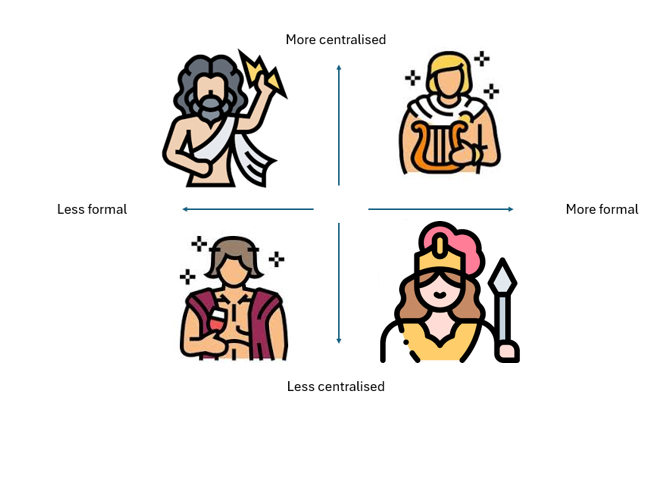
As I’ve suggested, it can feel very ‘modern’ to want a less centralised and less formal approach to leadership: the Dionysus approach. Dionysus is a fun God. He represents wine, theatre and fertility and as a culture it’s very social and engaging. But in equal measure Dionysus represents over-indulgence and chaos! This culture is a balance, and I believe hard to live in 100% of the time without risk, but equally fertility in the business world is where we are most creative and innovative. There’s a danger in never embodying this culture too.
Opposite Dionysus is Apollo. Apollo represents order and reason. Businesses with an Apollo culture often see formal centralised decision-making start with a senior team and then cascade through hierarchies of leadership in business units. For this reason, this culture is often also visualised as a Greek temple. It’s the culture I’m most familiar with from my own experience, and perhaps for that reason I quite like it because it feels safe. But when it comes to progression it can leave people feeling like they just have to ‘wait for the next level up’, and without a golden thread of communication decisions can be slow and fail to take into account the ‘bottom’ levels of the temple.
Then we have the Zeus culture. One key figure who makes decisions that everyone follows. If Zeus wants it done, then it gets done. There’s not the formality that we see in Apollo culture, with established cascading of responsibility and communication. This can be positive as it allows for more agility and in times of change and transformation this could be healthy – especially for a small start-up business for example. But it can also create confusion. If nobody has assigned responsibility who is responsible? And for those wanting to progress what’s their next step? Gen-Z might particularly struggle with this authoritarian approach.
And the last culture is Athena: based on the Goddess of strategic warfare and wisdom. Athena is task focused. Power sits where the knowledge is needed and not at the top of a hierarchy. As situations change, so do structures. This is why Athena is often visualised as a net as opposed to a ladder where the interconnectivity needs to work together to make the proposition stronger. It focuses on problem solving and can be particularly useful for project work (ironically the NASA Apollo missions have high levels of Athena culture despite the name). But the culture relies on the knowledge of the team being high enough to make the right decisions. Athena culture needs to invest in more “T-shaped” learning where specialist expertise is also supported by a broader foundation of knowledge across the business to work well.
I believe in layering Handy’s work with situational leadership. For example, I can see I mostly operate in Apollo culture and given high levels of compliance that might feel natural. But Athena allows an agility and opportunity for development that is genuinely enriching for individuals and businesses. So, alongside Apollo structures, creating regular projects can mitigate against some of Apollo’s shortcomings. However, given I work in a creative industry the ‘sparkle’ that comes from Dionysus also feels essential for some initiatives. Whilst not an everyday approach, actively seeking opportunities for this more free-thinking environment creates a more innovative mindset. This balance might be different for different individuals and sectors, but I believe operating in Dionysus in small doses provides a cultural boost even for businesses who typically fall into the other cultures. I’d like to feel we have a Dionysus culture at least once a quarter.
Like all theories, Handy’s work is not a prescription. It needs to be thought about and layered onto the backdrop of the industry and individuals’ needs, but I still believe it has a lot of say about culture even 50 years after it was released!
CAVEAT: I may have a bias towards Athena. I named my cat after this Goddess after all!